Eleven hours out with Nova Sinclair
Appetite
She made Warm Current in one small room. She did not write it there — she wrote it out here, on wet corners, at bars she won’t let us name, in other people’s kitchens at one in the morning. The loudest happy record of the year, explained by the woman who refuses to go home.
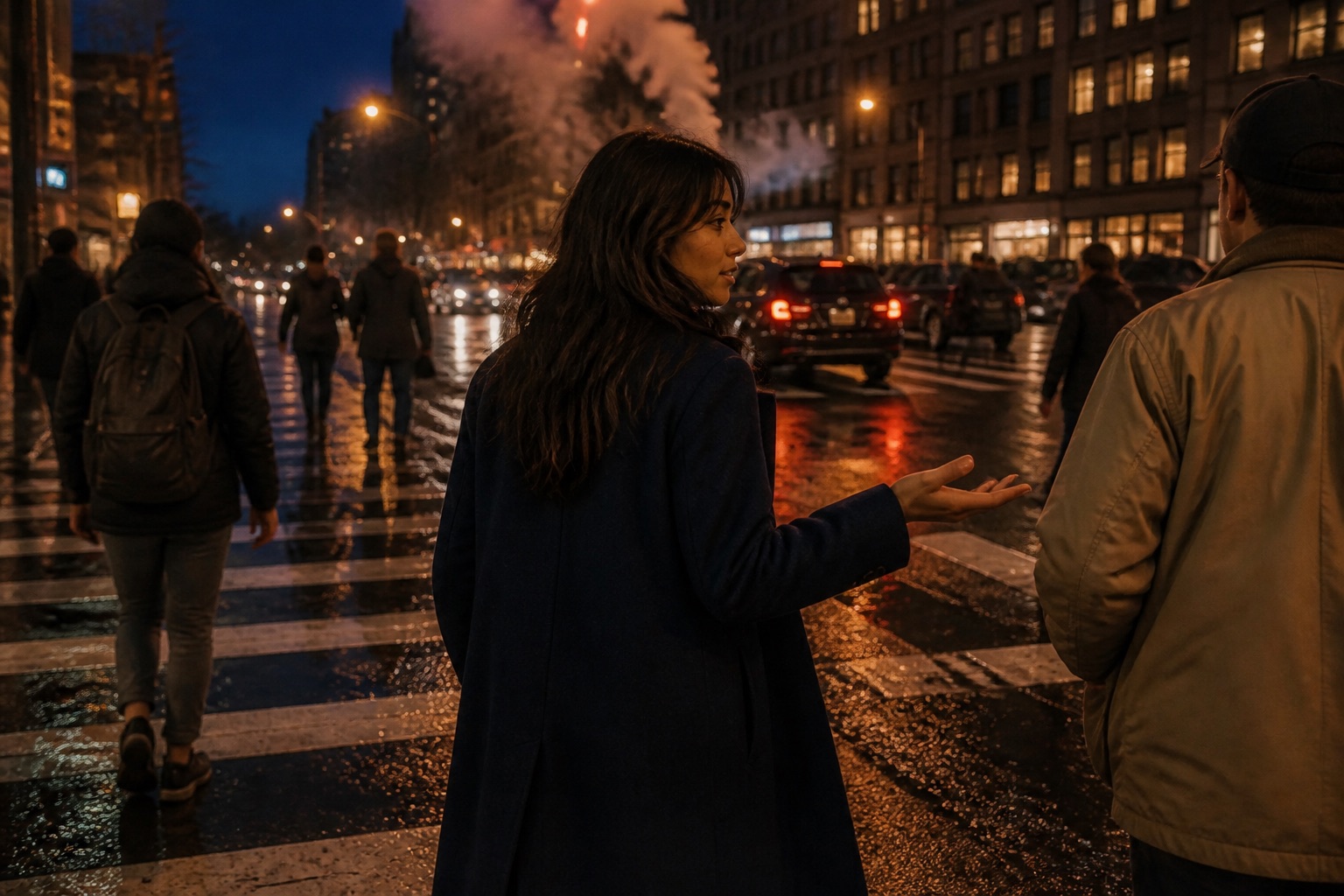
The plan was to do this upstairs, in the apartment studio where Warm Current was recorded, and the plan lasts about forty seconds. Nova Sinclair comes down instead of buzzing me up, in the blue coat, already moving.
Nova“If I sit you in that room you’ll write the room piece. Everyone writes the room piece. Four walls, tortured artist, isn’t it sad how she suffers for the songs.” She is walking east before I have my recorder out. “I made a record in there. I don’t live in there. Are you hungry? You should be hungry.”
I am not, particularly. This turns out not to be relevant.
What follows is eleven hours, roughly nine miles on my phone’s count, four neighbourhoods, one bar I have agreed not to name, one kitchen belonging to a woman called Mireille who I had never met and who by 2 a.m. was showing me her mother’s records, and a final twenty-block walk in which the person I had come to interview interviewed me about my divorce. Somewhere in there we discussed the album.
She walks fast. Not in a hurry — fast the way people walk when the walk is the good part. Twice she stops mid-sentence because something on the street is more interesting than what she was saying: a man arguing tenderly with a parking meter, a kid in a puffer jacket teaching a smaller kid to whistle. The second one goes into her phone.
She orders for the table without consulting me, which is to say she orders for four people and there are two of us. Dumplings, then noodles, then more dumplings when the first ones are gone, then a beer she drinks a third of and abandons. She eats like somebody with a schedule to beat and talks continuously through it.
This is the part of the evening where I make my mistake. I ask, with what I imagine is subtlety, about the happiness on the record — how it sits with her, whether she worried it would read as soft.
Nova“It’s not a happy record. That word’s going to be on every piece and every one of them will be slightly wrong.” She points a chopstick at my recorder, amused. “It’s a record about wanting. That’s not the same. Happy is a temperature; wanting is an engine. You don’t make anything loud out of being content.”
So: appetite as method. She is entirely serious about it and completely unwilling to dress it up. The sub-bass on Warm Current — the physical low end that gives the record its weight — she describes flatly as the sound of a person who wants things. Food, noise, sex, company, the last train, a second opinion at 1 a.m., all of it.
“I got happier and the records got heavier. Everyone finds that confusing. It’s not confusing. I just stopped pretending I didn’t want anything.”
Nova Sinclair
Her last record — one voice, one room, almost no production, the thing she calls the hinge — said what she wanted out loud. She is clear that the saying was the hard part and that it is over. Warm Current starts afterwards, in a life where the wanting is answered and has to be carried around all day like a full glass.
Outside a laundromat two women are having an argument about a cousin. We are past them in four steps. Nova has her phone out.
“He was only ever nice to us in front of other people.” She types it, thumb moving, not breaking stride. “That’s a whole song. Not tonight. But that’s a whole song.”
The note is called, she says, nothing — it is just the top note in her phone, and it goes back years, and it is mostly strangers. Lines lifted off corners, out of bars, from the back of cabs. When I ask which ones on Warm Current came from it, she laughs at me.
Nova“No. Absolutely not. Those people don’t know they gave me anything and they’re not going to find out from a magazine.” A beat. “Also you’d listen differently and I’d have ruined it.”
It reframes something about her, this note. The received version of Nova Sinclair is the interior one — the writer of emotional aftermath, precise about her own weather. The version walking next to me is an eavesdropper with a magpie habit and a genuine, almost indiscriminate interest in other people’s lives. She is not mining her feelings out here. She is collecting other people’s, and taking them home to see what they do to hers.

She will not let me print where we are. Her reasoning is not precious; it is practical, and delivered with the bluntness of somebody who has watched it happen to other places. “Put it in the magazine and it stops being this. Then I have nowhere to go and you have a paragraph.”
What I can tell you is that the bartender, Desh, starts making something before she reaches the bar; that four separate people say hello to her in the first ten minutes, and that none of them mention the album; and that she asks every single one of them a real question and then waits through the whole answer. A man in his sixties tells her about a hip replacement in considerable detail. She is riveted. I have watched famous musicians simulate this. She is not simulating it.
She also, over the course of about ninety minutes, extracts from me: where I grew up, what my father did, why I stopped playing, and the fact of my divorce, which I had not intended to mention to anyone in a professional capacity ever again.
Nova“You’re annoyed.” She is delighted. “Look, I’ll answer whatever you want. But you came out with me, and if I just talk about myself for eleven hours I’m going to be unbearable and you’re going to have a boring night. Nobody’s ever interesting about themselves for that long. Nobody.”
For the record — because it is the obvious question and she gets it constantly — the person she lives with does not come up all night except in passing, twice, and both times she says something warm and specific and immediately closes the door on the subject. She is not being coy. She is being consistent: she kept them out of the songs on purpose, and she is not going to hand them to a journalist at midnight because the vibe was good.

There are six of us around a table meant for four. Somebody has made eggs. Mireille, who I gather has been feeding this particular group at this particular hour for most of a decade, refereeing an argument about whether a certain 1998 album is a masterpiece or a production error, is the reason I now understand something about Warm Current that no listening session would have told me.
Nova is the loudest person in this room. Not the most talkative — the most emphatic. She defends the 1998 record with her whole body, gets shouted down, changes her mind out loud, admits it, and then reverses again twenty minutes later because of something someone said about the drums. It is the least guarded I have seen any musician be about music.
At some point somebody puts on No Emergency, the record’s lead single and its heaviest early track, mostly to embarrass her. It works; she puts her face in her hands. Then she talks about it anyway.
Nova“That one came out angrier than I expected and I kept it that way. I’d been braced for so long that calm read as a malfunction — nothing’s wrong and I’d go looking. It’s not angry at anyone. It’s angry at me for being unable to sit still inside a good thing.” She takes her hands down. “Which, look at me. One in the morning. Point stands.”
The night, itemised
- 7:12 Comes downstairs rather than let a writer into the studio.
- 7:26 Stops to watch a kid being taught to whistle. Types it into her phone.
- 8:05 Orders for four. Two of us.
- 8:52 Second round of dumplings. Beer abandoned, two-thirds full.
- 9:40 Steals a line off two women outside a laundromat.
- 11:20 Bar. Desh starts the drink before she arrives.
- 11:31 Man in his sixties, hip replacement, riveting.
- 12:15 Turns the interview around. Wins.
- 1:04 Mireille’s kitchen. Eggs. Six people, four chairs.
- 1:50 Loses an argument about a 1998 record. Reverses at 2:11.
- 3:15 Declines a cab. Twenty blocks on foot.
- 5:50 Goes up to work. Does not go to bed.
We could get a cab. We do not get a cab. Twenty blocks, and this is the stretch where she is quietest and most exact, because the conversation has finally arrived at the thing she is actually frightened of, which is not being loved but being absorbed.
The Room Is Still My Room sits at the centre of the album and is the only song she says she was scared to release. It is about somebody learning where everything in her room is — the books, the gear, the order of it — and moving none of it.
Nova“I grew up assuming love came with a bill, and the bill is you. You hand over some part of yourself at the door and everyone agrees to call it compromise.” The avenue is empty enough to hear her at half volume. “I kept waiting to be asked for the room. Nobody asked. Took me about a year to stop bracing for the invoice.”
“I don’t go up there to hide from the night. I go up there to file it.”
On the room, at four in the morning
She talks about Soft Voltage for exactly one block — the heaviest thing on the record and, she says, the least lonely, desire without the confessional charge it carried last time, which makes it more intense rather than less — and then announces that she is not going to be interviewed about sex on a public street, which is fair.
She is happier to talk about the last track. Morning, Still is built on a single felt-piano note lifted from the record where she asked for what she wanted, stretched into a pad wide enough to sit a song on. Nobody would find it. She tells me anyway, and explains why she tells everyone: unidentifiable is not the same as absent, and she wants it known that the record about being answered is built on top of the record where she asked.
Here, finally, is the room, and it gets one paragraph because that is what it deserves. Forty square feet at the end of a hallway. A desk against the long wall, monitors up on books, a synthesizer, an electric guitar leaning in front of the power strip — which is, she says, the actual and entire reason the gear never gets switched off. Two mugs in different places. It smells like warm electronics. It is not a shrine and she is visibly bored of people wanting it to be one.
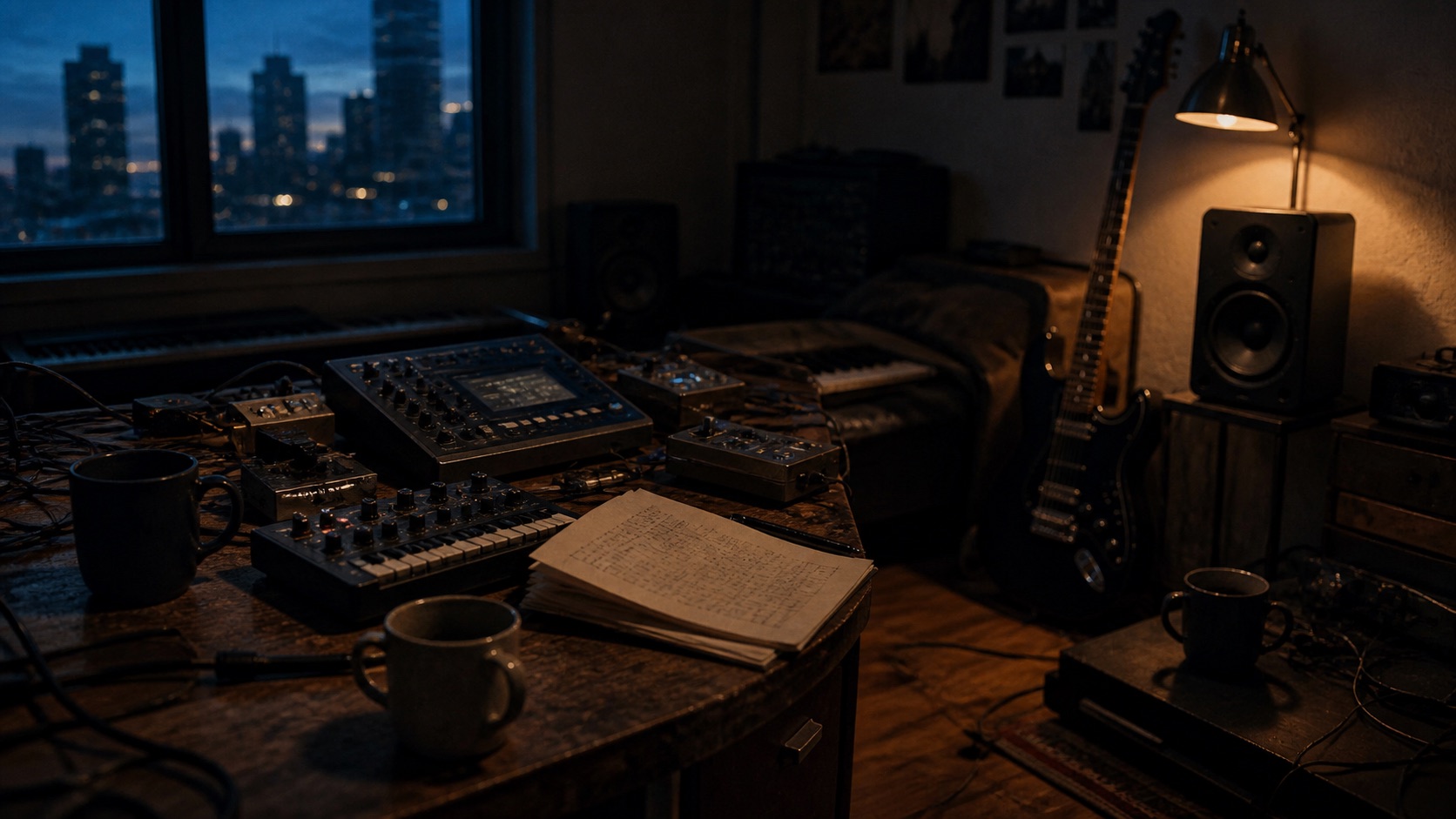
She is not going to bed. This is the part I had wrong before I met her, and I suspect most people have it wrong: the room is not the beginning of her day, it is the end of her night. Everyone else goes home to sleep; she goes home to work, five until nine most mornings, while the material is still warm. Fourteen months of that made this album.
At the door she asks whether I got what I needed, in the tone of somebody who already knows the answer is yes and is asking anyway, and then says the last useful thing of the night.
Nova“People think the good life made me quiet. It made me hungrier. I’ve got more to lose and I want more of it and that’s the whole record — it’s loud because I’m not finished.” She is already turning. “Go to bed. I’ve got about four hours.”
Five things on Warm Current
No Emergency — Lead single, heaviest of the early run. Half-time, sub pressure, the biggest chorus here. Angry at her own vigilance, not at anyone.
Good at Staying — The cleanest pop structure on the record and the closest thing to a thesis. Staying as a practice you get better at, not a personality.
The Room Is Still My Room — The centre, and the only one she was frightened to release. Close vocal, low synth, room tone, then it opens.
Soft Voltage — Heaviest and least lonely. Baritone guitar, distorted bass, drums like slow machinery, verses almost whispered.
Morning, Still — Built on one stretched felt-piano note sampled from the record where she asked. No big ending; the low end waits until the final minute.
The file
Warm Current — ten tracks, released 15 May 2026 through Two In The Morning, TIM-005. Her own imprint: a catalogue number, a bank account, her own filing.
Written, produced, mixed and art-directed by Nova Sinclair, in one room in New York, 2025–26. She owns the masters, the mixes and the mistakes.
Reported over one night in New York. Nothing was arranged in advance except the time she came downstairs, and that only barely.
Warm Current is out 15 May 2026 on Two In The Morning.
Nova Sinclair on Sidetrax
Sidetrax — The Cover Story, May 2026