Fourteen months. Forty square feet. One door.
Nothing
Is Wrong
For six years Nova Sinclair wrote beautifully about people leaving. Then somebody stayed, and she discovered she had no vocabulary for it at all. A night, and then a morning, in the room where Warm Current was made.
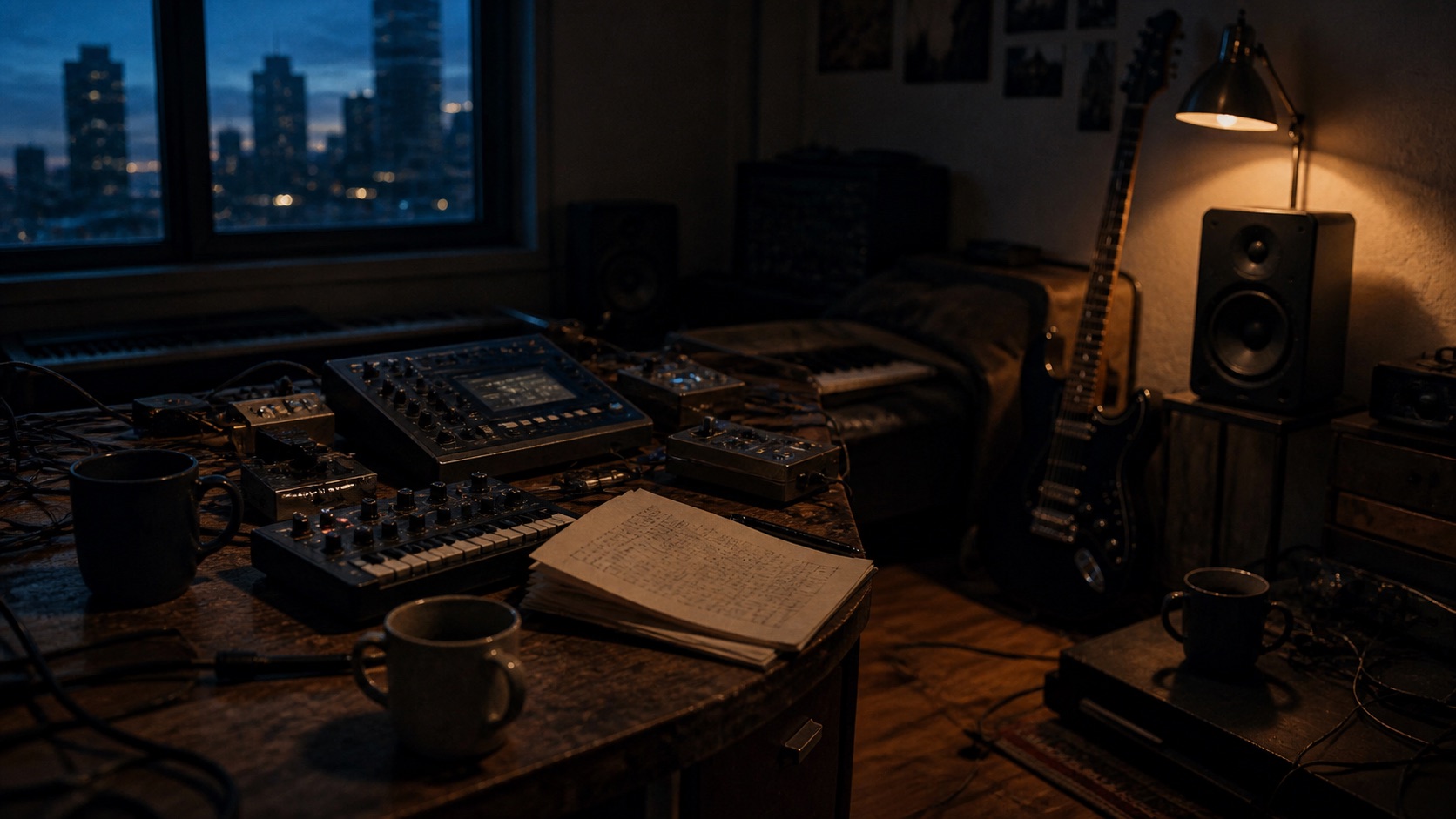
The room is smaller than the record. That is the first thing, and she knows it is the first thing, because she watches me work it out and does not help. Forty square feet, give or take: a desk against the long wall, monitors up on a stack of books, a synthesizer, a sampler, four pedals of which one has been broken since before the album started, and an electric guitar leaning in the exact place you would have to move it from to reach the power strip. Everything is on. There is a hum in the room at all times, low enough that after twenty minutes you stop hearing it and start feeling it in your sternum.
“That’s why it stays on,” she says, when I ask about the gear left running overnight — a detail she puts in the sleeve notes and which I had arrived ready to find meaningful. “The guitar’s in front of the plug. That’s the whole reason. People want it to be about not wanting to break the spell.” She sits down on the floor with her back against the desk, knees up, which is where she stays for most of the next five hours. “It’s about not wanting to move a guitar.”
This is roughly how the evening goes. I bring her a reading of her own record; she takes it apart with the air of somebody who has already had the argument with herself and lost it, twice, in this room, at this hour.
Warm Current comes out on Friday — ten songs, fourteen months, made entirely here, released as everything of hers has been released, through Two In The Morning, which is not a label so much as a catalogue number, a bank account and her own filing. It is the loudest thing she has made. Sub-bass you can feel through a floor, baritone guitar, distortion that arrives like weather. It is also, and this is the part she is bracing for, a record about being happy.
Every piece about this record is going to use the word happy.
I know. I’ve thought about it a lot and I can’t stop it, so.
It’s not that it’s wrong. It’s that it’s the least interesting true thing you could say. Happy is a temperature. It doesn’t tell you what the record does.
What’s the word you’d take instead?
Loud.
She means it structurally. The thesis of Warm Current, insofar as an album has one, is that happiness in a body is not an acoustic guitar on a nice afternoon; it has mass, it moves furniture, and to write it honestly you need the low end. Her previous record went the other way — one voice in one room, almost no production, the thing she has called the hinge. That record said what she wanted. This one starts four seconds after somebody said yes.
“I want to be really clear that absence is a skill,” she says. “You can describe the edge of something that’s gone and everyone in the world recognises the outline. That’s not nothing. I got good at it. Six years.” She pulls at a loose thread on the knee of her jeans. “Presence has no edge. It’s just there, the whole way through the day. The first time I tried to write it down I wrote four verses of absolute nothing.”
I ask whether that song still exists somewhere.
“No. I deleted it.” A beat, faintly amused at my expression. “I don’t keep the failures. There’s no vault. People think there’s a vault.”
“I checked the door about once an hour for a year. Not because I thought anyone was leaving. Because checking was what I knew how to do.”
Nova Sinclair
The actual event of the record — the thing she says happened, as opposed to the things that got songs — is the door.
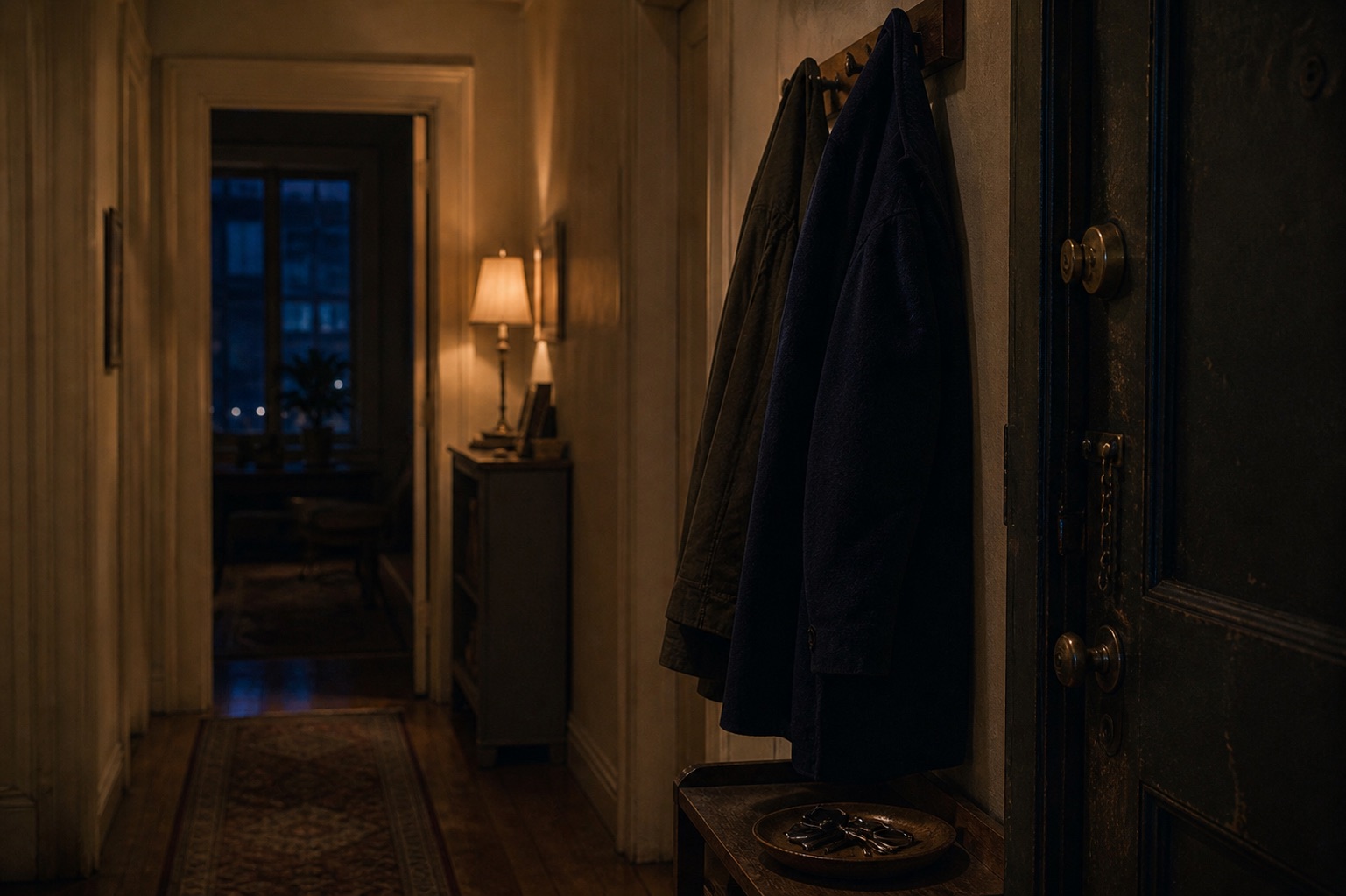
It is nine feet from where we are sitting, a plain apartment door with a deadbolt and a coat hook beside it and, in a dish, two sets of keys. For most of the fourteen months she checked it. Roughly at the top of every hour. Not deliberately, not as a ritual she could have described at the time; she would notice she was standing in the hallway with her hand on it, having got up from a session mid-bar.
“Nobody was leaving,” she says. “There was no evidence. That’s what I’d like people to understand about this record, actually — nothing was wrong. That’s the whole problem. I had a nervous system built for a house on fire and no fire.” She looks at the door with an expression I can only describe as professional dislike. “It’s only a door. I wrote that line down about eleven months before I believed it.”
She stopped somewhere around the writing of Good at Staying — the album’s brightest and most conventionally structured song, 112 BPM, a chorus you could hum at somebody — and she is careful, when she tells me this, not to let it become a story about a song fixing her.
So the record is the recovery.
No.
She says this pleasantly and without any give in it at all.
The record is fourteen months of me being visibly ridiculous in a small room, and the songs are what I made while it was happening. Nothing got fixed by writing. I’d genuinely rather people didn’t take that away from it, because it isn’t true and someone will believe me.
What made you stop, then?
Time. Repetition. Somebody being where they said they’d be about four hundred times in a row.
It’s boring. That’s the honest answer and it’s why nobody writes it. The interesting version is: and then I learned to trust. The real version is four hundred Tuesdays.
No Emergency, the record’s heaviest early track and its lead single, came out of one of those Tuesdays. She caught herself checking a silent phone, sat down at this desk, and had it more or less finished by morning. The anger in it — and it is angry, a half-time chorus that lands like a door slamming in a much larger building — is not aimed at anyone.
“It’s at me. It’s at the version of me that hears nothing is wrong and reads it as a threat.“ She half-laughs. ”You say that sentence through your teeth for a while before you can say it normally.“
About the person the keys belong to, she will say almost nothing, and the almost is deliberate. They are not in the songs. They were not in the room tonight and will not be in the room tomorrow morning. When I push — mildly, once — she gives me a look of real patience and says: “They didn’t sign up for this part. I did.”
What she will talk about is what it cost her to be known. The Room Is Still My Room sits at the centre of the album and is the only track she says she was frightened to put out. It is a song about somebody learning where everything in her room is — the books, the gear, the order of the pedals — and moving none of it.
“I grew up assuming love came with a bill,” she says, “and the bill is you. Some part of yourself gets handed over at the door and you call it compromise, and everyone agrees to call it that.” Her voice drops under the hum; I check the recorder twice afterwards to be sure I have it. “I kept waiting to be asked for the room. Nobody asked.”
She has never played it to them.
Not once? It’s out on Friday.
They’ll hear it the same day you do.
I write the truth before I’m brave enough to say it out loud. People quote that back to me like it’s a slogan I’ve grown out of. I have not grown out of it. It’s a description of a limitation.
It is somewhere past three when we get to Soft Voltage, the heaviest thing on the record and, she says, the least lonely — desire written without the confessional charge it carried on the last record, which makes it more intense rather than less. “Nobody’s performing. Nobody’s being watched. It’s Tuesday.” Then, flatly, pre-empting me: “And no, I’m not going to talk you through it.”
We talk instead about independence, which she discusses like a logistics problem rather than a virtue. She owns the masters, the mixes, the images and the mistakes. She knows what that costs her in reach and quotes no numbers at me. “I could have more listeners. That’s just true. I’d have to hand somebody the fader to get them.” She shrugs. “I’ve never made a song about it. It’s not interesting and I chose it.”
I ask, because it is my job, where she is from. She says, “Somewhere coastal,” and smiles at me until I move on.
“There’s one note from the last record inside this one. I sampled it, stretched it, and built the last song on top of it. You’d never find it. That’s why I’m telling you.”
On Morning, Still
The album ends on Morning, Still, which is not a finale — the low end does not even arrive until the last minute — and it is built on a single felt-piano note lifted from the record where she asked for what she wanted, stretched into a pad wide enough to sit a song on. She volunteers this unprompted and then explains why she volunteers it: unidentifiable is not the same as absent, and she would rather people knew the foundation was there.
By six the window over the desk has gone the colour of wet slate, and then, quickly, copper. The light comes across the gear as if it has been waiting all night for the chance, which is a sentence I write down and then feel slightly embarrassed by, because she has spent five hours dismantling exactly that sort of sentence.
She makes coffee in two mugs, leaves one of them somewhere she will not find it, and says the last useful thing of the night, which is about the ending of the record and also, obviously, not about the record at all.
“It doesn’t promise anything. It’s a morning. I woke up inside it.” She sits back down at the desk, and it is clear that the interview is over in the way that things end in this apartment, which is that she has already started working. “And then I got up and went back to work. That’s not an anticlimax. That’s the good version.”
I let myself out. On the way past I look at the door, which is a door.
Warm Current is out 15 May 2026 on Two In The Morning.
Nova Sinclair on Sidetrax
Sidetrax — The Cover Story, May 2026