Petros Laskaris
He made machines carry the weather people could no longer see.
Releases
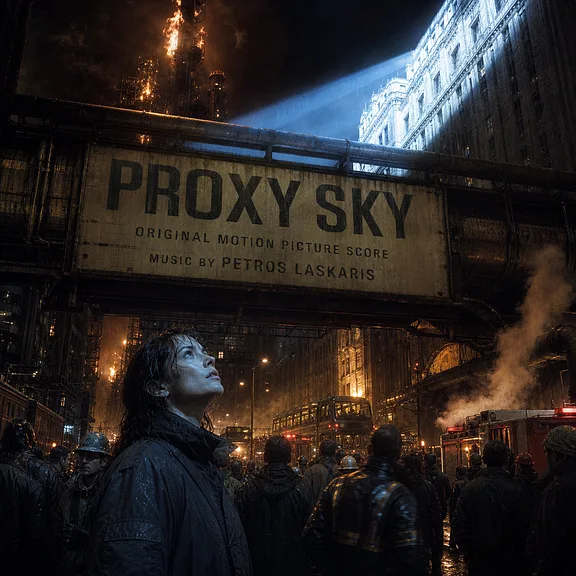
Proxy Sky (Original Motion Picture Score) Album
Petros Laskaris
Biography
Petros Laskaris spent most of his career making music people recognised without knowing his name.
Born in East Ham in 1953 to Greek parents, he learned electronics beside his father, who repaired cinema projectors and industrial control systems, and melody from his mother, who sang at community functions without ever calling herself a singer. By the late seventies he was maintaining tape machines in Soho and recording after hours, treating synthesis as something performed by hand rather than programmed into obedience.
His 1981 private-press album Light Industry found a small audience among choreographers and film editors. The work that followed moved between architecture documentaries, contemporary dance, installations and television: huge analogue chords, interlocking sequencer patterns, sampled glass, electromagnetic noise and synthesizer melodies simple enough to survive being misremembered.
Laskaris distrusts the word “soundscape.” A cue, he insists, must contain something a person can carry out of the room.
Judith Kershaw hired him for Proxy Sky before principal photography. He wrote its artificial-dawn theme before the sequence was filmed, and parts of the city’s projected light were timed to his early demos. The completed score disappeared with the film after Meridian Pictures changed ownership in 1995.
Restored from Laskaris’s sequence masters and surviving magnetic stems, Proxy Sky reveals the defining work of a composer whose defining film never entered history.