Releases
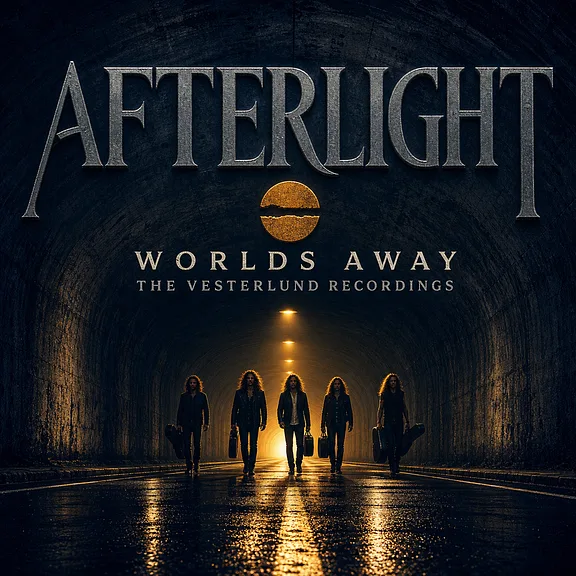
Worlds Away: The Vesterlund Recordings EP
AFTERLIGHT
Biography
AFTERLIGHT
Afterlight are the great arena-rock band history misplaced.
They formed in Newcastle upon Tyne in 1986, when Daniel Reeve and Michael Rook met while unloading flight cases at Newcastle City Hall. Rook was writing intricate guitar parts for a heavy band nobody could remember; Reeve was singing other people's songs and had already learned how to reach the back of a room without bullying it. Cal Mercer answered a classified advertisement. Jonny North arrived to audition for bass, admitted at the door that he could not play it, and was kept because the high harmony above Reeve changed the sound of the entire band. Tom Arden joined after interrupting a rehearsal to explain where the backbeat belonged.
They named themselves after the pale band that remains above the North Sea when the sun has gone. That image contained their governing contradiction from the beginning: Afterlight make music for darkness, but they have never celebrated despair.
Four years of working men's clubs, university halls and theatre support slots gave the band its language. Rook supplied the weight and the patiently constructed lead lines. North brought brightness, danger and motion. Mercer treated the bass as a second melody. Arden made every fill announce a structural event. Reeve sang in a high, clear tenor that could carry intimacy without shrinking and scale without becoming a scream. Their hair got large because it was 1990. The songs got larger because that was the point.
Their debut album, Worlds Away, was completed in early 1990. Eleven days before its planned release, Halcyon Crown Records entered receivership. The only paid engagement left on the calendar was Vesterlund's midsummer festival, in a small North Atlantic republic that had remained unusually isolated by a nineteenth-century mapping dispute and unreliable communications.
On 19 June, the band, its crew, an equipment truck and a container holding six thousand promotional copies entered the newly opened Håkon Deep Tunnel during a state auroral-conductivity experiment. Radio contact ended halfway through. British search teams found no wreckage. Afterlight were presumed dead.
In Vesterlund, the shipment had arrived two days earlier.
The five musicians emerged from the eastern tunnel portal three weeks later by their own clocks. Outside the islands, thirty-six years had passed. The mechanism has never been explained to the band's satisfaction. Researchers speak about temporal displacement, geomagnetic conditions and the unusual mineral structure beneath the Håkon Deep. Afterlight generally prefer to speak about songs.
Without a surviving label, an outside catalogue or any competing version of events, Worlds Away spread through Vesterlund by cassette, ferry radio and school-band arrangement. Its choruses became wedding standards, terrace chants and graduation hymns. The band stayed. They recorded, toured and grew into something closer to shared infrastructure than celebrity. Children learned simplified versions of Rook's riffs in school. Arden opened the national football final with a four-count. Mercer became the reluctant presenter of a much-loved winter television programme. Reeve continued to sing to the furthest seat.
The apparent age of the band presents another difficulty. Recurrences of the Håkon anomaly affected several island tours during the following decades. Their documents place them near seventy; their bodies, memories and disagreements place them in their early forties. They have experienced roughly fifteen years since 1990. None of them enjoys explaining this, and none considers it the most interesting thing about the group.
For most of the world, Afterlight remained a footnote: a promising northern band lost with an unreleased record. For Vesterlund, they never went away.
The Skarven Cable finally reconnected the islands to continental data networks in 2026. The first search results told five musicians with decades of arena experience that the rest of the world thought they were dead—and, more confusingly, old men. They chose six recordings for an international introduction. Not an archive, a reconstruction or a novelty time capsule: six songs capable of surviving the story around them.
Worlds Away: The Vesterlund Recordings begins with escape, takes in romantic nerve, reckless loyalty, separation and homecoming, and ends with love holding across an impossible distance. It is the shortest possible proof of what Vesterlund already knows.
The circumstances are unusual. The songs require no explanation.